Effects
Vocoder
Impose the changing spectrum of one signal onto a carrier, for robot-voice and similar effects.
Splits the audio into a bank of frequency bands, tracks how the level in each band changes over time, and uses those envelopes to shape a carrier signal. The familiar result is the robot voice: speech articulation carried by a synthetic tone.
Where to find it
Effect → Distortion and modulation → Vocoder.
Setting up the track
What is used as the carrier depends on the track. On a stereo track, the left channel is the modulator and the right channel is used as the carrier — put the speech left and the synth or pad right. On a mono track there is no separate carrier, so the effect builds one from sine waves, white noise and radar needles according to the amplitude controls below.
Controls
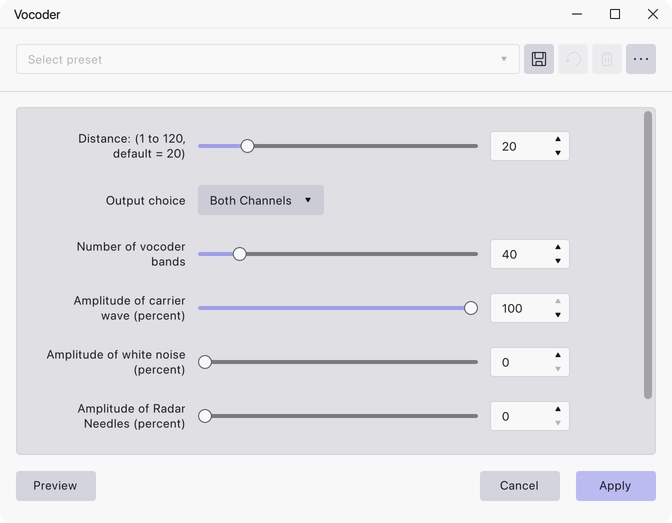
- Distance: (1 to 120, default = 20) — 1 to 120, default 20. Sets how quickly each band’s level envelope responds. Low values track the modulator tightly and keep consonants crisp; high values smooth the envelopes out, so the effect sounds more distant and less articulate.
- Output choice — Both Channels or Right Only. Both Channels is the default.
- Number of vocoder bands — 10 to 240, default 40. More bands follow the modulator’s spectrum more faithfully; fewer bands sound coarser and more obviously synthetic.
- Amplitude of carrier wave (percent) — 0 to 100, default 100.
- Amplitude of white noise (percent) — 0 to 100, default 0.
- Amplitude of Radar Needles (percent) — 0 to 100, default 0.
- Frequency of Radar Needles (Hz) — 1 to 100, default 30.
Notes
The three amplitude controls set the mix of the generated carrier on a mono track. Adding white noise puts breath and sibilance back into a vocoded voice, which otherwise loses its consonants; radar needles add a periodic pulse whose rate is set by the frequency control, giving a buzzier, more pitched carrier.
For intelligible speech, keep the band count reasonably high and add a little noise. For a deliberately crude, early-vocoder sound, drop the band count.
Last updated